ACT, SAT & CLT Information

Program Notice: TOPS Testing Deadlines
Please be aware of the following testing deadlines for TOPS Eligibility:
ACT: The April national test day is the last opportunity for students to receive a qualifying score without a penalty for the TOPS Scholarship.
SAT: The March national test day is the last opportunity for students to receive a qualifying score without a penalty for the TOPS Scholarship.
CLT: Students must achieve a qualifying score no later than the national ACT test date in April of the year they graduate from high school.
Students who use a later qualifying score will receive a one semester or two quarter reduction of their TOPS Award. The highest score MUST be used to qualify for TOPS, even if taken after these deadlines.
ACT Information
TOPS Scholarship
The ACT is required for students to meet the initial eligibility requirements for the Taylor Opportunity Programs for Students (TOPS). Students may substitute an SAT test to meet this requirement. TOPS does not use the Essay portion of either test as a qualifier for the TOPS Scholarship. TOPS requires a composite score, and does not accept ACT Superscores.
Students must achieve the minimum score for one of the five award levels of the TOPS Scholarship, as shown below. *
- TOPS Opportunity Award – Never less than a 20, prior year Louisiana state average (currently, a 20)
- TOPS Performance Award – 23
- TOPS Honors Award – 27
- TOPS Excellence Award – 31
- TOPS Tech – Minimum score of a 17 or ACT Silver Workkeys.
*Students who are registered as a home study student with the Louisiana Department of Education, out of state high school graduates and out of country high school graduates who meet the other TOPS Initial Eligibility Requirements must meet the ACT requirements for TOPS Alternate Eligibility.
ACT Test Day Deadline
The April national test day is the last opportunity for students to receive a qualifying score without a penalty for the TOPS Scholarship. Students who use a qualifying score for the June or July test will receive a one semester or two quarter reduction of their TOPS Award.
The ACT is administered on national test days throughout the United States. Click here for test dates and registration deadlines.
ACT Registration: LOSFA’s ACT code is 1595
Making Sure Your Registration is Complete
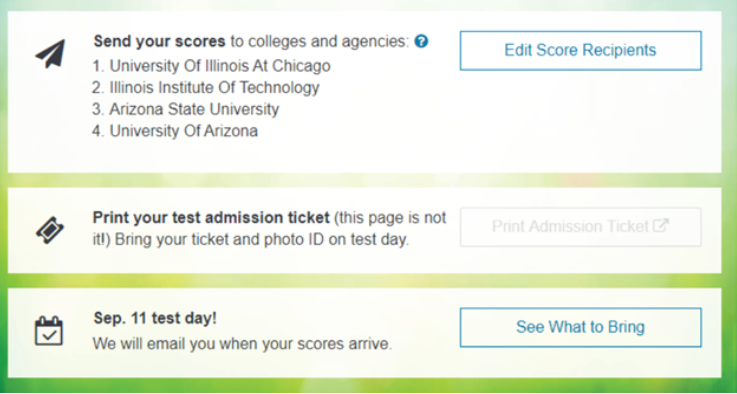
The confirmation page will appear after you have entered your payment information. This page will list your confirmation number, admission ticket, and instructions for test day. Print this page for your records.

After you have successfully registered, you should see options similar to the example shown below. You can print your admissions ticket at any time prior to the test date by clicking Print Admission Ticket.
Requesting Accommodations and English Learner (EL) Supports
To request accommodations, you must work with a school official because the accommodations requested should be based on the accommodations the student currently receives in school. Accommodations MUST be approved by ACT prior to the testing. Simply requesting an accommodation is not sufficient.
All requests, including appeals, must be submitted by the late registration deadline for the preferred test date. If the request is not properly submitted, it may not be approved in time for the preferred test date. Click here for more information.
How to Make a Request?
Examinees Who Are in School
- Register to test by logging into MyACT to complete the following:
- Link a valid high school to your MyACT account before you register to allow ACT to communicate your registration to the associated school official in TAA.
- Select ‘Yes’ when prompted to confirm you need accommodations after beginning the registration process. If you selected ‘no,’ you will need to contact ACT as soon as possible to update your registration if you need to test with accommodations.
- Work with your school official to submit your request. After you register for the ACT, you will receive an email that you must forward to your school official. You will also need to provide a completed Consent to Release Information to ACT form. Your school official must submit your accommodations request to ACT before the late registration deadline for your test. Once submitted, requests can take 5-10 business days to process.
- Review the decision notification with your school official. Your school official will receive a copy of the decision notification regarding your request for accommodations. If your request was denied, review your decision notification with your school official to decide if you want to appeal the decision. You have until the late registration deadline to submit an appeal. Note: Contact your school official if you have not received an update regarding the status of your accommodations request after 10 business days.
- Approved for special testing? Make arrangements to test!
Once your request for accommodations has been approved, you are responsible for working with your school official to make arrangements to test within the special testing window. Students approved for special testing typically test at their own school. If your high school cannot administer the test, contact ACT as soon as possible. - Print your admission ticket.
Be sure to upload your photo (if you have not already done so) and review your admission ticket, to ensure your accommodations are reflected on your registration. If you are testing at a national test center, check your testing location. It may have changed to ensure your accommodations can be provided.
Examinees Who Are Homeschooled or Not Currently Enrolled
- Create or log in to an existing account and register to test. Online registration will ask you to indicate your accessibility needs.
- You will automatically receive an email that will provide a link to the application for your request. If you do not receive this message, you may email ACT for a copy.
- Complete all required documentation:
- Completed Exceptions Statement (PDF)
- Diagnostic documentation and/or English language proficiency scores
- Documentation to substantiate your need for accommodation, such as:
- Prior IEP, 504 plan, or educational plan
- Recommendation for test accommodations and/or supports from diagnosing professional, including rationale for each requested item
- Brief personal statement regarding any previously provided accommodation and/or EL supports in an educational environment, and a rationale for the current request
- Return your completed paper request with all required documentation by the published late registration deadline to ACT via:
- Email: [email protected]
- Fax: 319.341.2415
- Mail: ACT Special Testing, 301 ACT Drive, PO Box 4028, Iowa City, IA 52243
ACT FAQ
How to Register for an ACT Test
You will need about 30 minutes and the following:
- Computer with Internet Access
- Credit Card or Other Payment Method
- High School Course Details
- Headshot Photo
ADDITIONAL INFORMATION FOR REGISTRATION
• You must submit a photo
To complete your registration, you must provide a recent photo of yourself for identification and test security purposes. This photo will print on your ticket and on the score report that is automatically sent to your high school. ACT will retain the photo for a period of time consistent with active use of test scores and test security purposes, and use as described in the ACT Privacy Policy.
• Accommodations and English Learner (EL) Supports
All requests for accommodations and EL supports, including appeals, must be submitted by the published late registration deadline for your preferred test date through the Test Accessibility and Accommodations (TAA) system. Temporary arrangements may be available for temporary conditions. Temporary arrangements are available for situations such as a broken arm. Contact [email protected] for a request form.
Students must request accommodations for each ACT test by the published late registration deadline.
When You Should Test?
Consider choosing a test date at least two months ahead of the application deadlines of all the colleges and scholarship agencies to which you might want to apply. Scores for the ACT are normally reported within 2–8 weeks after the test date. If you take the ACT with writing, scores will be reported only after all of your scores are available, including writing, normally within 5–8 weeks after the test date.
Click here to search for an ACT Test Center near you.
Click here to look up your high school code.
If you are registering for the writing portion, click here to learn more about the writing portion of the ACT test.
Are there any Free Online Test Prep Resources?
- Free ACT Practice Test found in their MyACT account (from ACT): https://www.act.org/content/dam/act/unsecured/documents/Preparing-for-the-ACT.pdf
- ACT Vocabulary Games and Tests: http://quizlet.com/6991782/act-test-vocabulary-prep-flash-cards/
- ACT Test Prep (Vocabulary) http://www.myvocabulary.com/act-test-prep/
- ACT Reading Comprehension Practice: https://www.testprepreview.com/act_practice.htm
- ACT Practice Tests: https://www.4tests.com/act-practice-test
- ACT Tips and Practice Tests: https://www.testpreptoolkit.com/act-practice-tests
- ACT Tips and Practice Tests: https://www.mometrix.com/academy/act-practice-test/
- ACT Prep, Expectations, Practice Tests: https://magoosh.com/hs/act-practice-test/
What is the ACT Waiver Program?
The ACT Waiver Program covers the registration fee for up to four ACT tests, with or without the optional writing test for National testing.
In addition to the registration fee, students who are eligible for the waiver also receive free learning resources and free additional score reports. Students who test with an ACT fee waiver may also request a Waiver or Deferral of College Admission Applications Fee. To have a college application fee waived, you must submit your fee waiver directly to the college you are applying to (not to ACT).
Am I Eligible for a Waiver?
To apply for the ACT fee waiver program, you must meet the following eligibility requirements:
- Be currently enrolled in high school in the 11th or 12th grade
- Be testing in the United States, US territories, or Puerto Rico
- Meet one or more of the indicators of economic need listed below:
- Enrolled in a federal free or reduced-price lunch program at school, based on US Department of Agriculture (USDA) income levels
- Enrolled in a program for the economically disadvantaged (for example, a federally funded program such as GEAR UP or Upward Bound) Note: If the student participates in a program, but is not economically disadvantaged, they are not eligible for a fee waiver.
- Resides in a foster home, is a ward of the state, or is homeless
- Family receives low-income public assistance or lives in federally subsidized public housing
- Family’s total annual income is at or below USDA levels for free or reduced-price lunches on the USDA Food and Nutrition Service website
How Do I Apply for the ACT Fee Waiver?
- Check with your school counselor to see if you are eligible to apply.
- Once your school counselor determines if you are eligible, you can receive up to four fee waivers to take the ACT test for free and you will receive free learning resources.
- When you register for the ACT online or by mail, use your ACT fee waiver code.
What to Expect on the ACT Test Day
Be fully prepared for test day by knowing exacty what to bring and what to leave at home.
From your admission ticket and photo ID to pencils, calculators, and snacks, we’ve got you covered so you can focus on doing your best.
What Should I Bring to the ACT Test?
You may bring:
- Admission Ticket
Print a copy of your admission ticket to bring to the test center. If you forget your ticket on test day, your scores may be delayed.If you have lost your ticket, you can print another through your MyACT account. - Acceptable Photo identification
Acceptable photo identification is required to be admitted to the test center. You will not be admitted to test if your ID does not meet ACT requirements. - Number 2 pencil
Bring sharpened, No. 2 pencils with good erasers (no mechanical pencils or ink pens). Do not bring any other writing instruments; you will not be allowed to use them. - Watch or Other Timing Device
You may bring a watch, timer, or stopwatch to pace yourself during testing, but it may not have an alarm. Your watch or other timing device must be removed and placed on your desk while in the test room, so that it remains visible to staff during the test. If an alarm sounds, you’ll be dismissed and your test will not be scored. - Calculator
Bring a permitted calculator to be used on the mathematics test only. You are not required to use a calculator at all, but if you do, it
is your responsibility to know whether your calculator is permitted. - Snacks
You can eat outside the test center on break.
What Not to Bring on ACT Test Day?
Don’t bring any of these (you can’t access them):
- Textbooks, foreign language or other dictionaries, scratch paper, notes, or other aids
- Highlighter pens, colored pens or pencils, or correction fluid/tape
- Any electronic device, other than a permitted calculator and acceptable watch or timing device
- Reading material
- Tobacco in any form
Prohibited devices
- The prohibited use of devices is in effect from the time you are admitted to your testing room until you are dismissed at the end of the test, including break times.
- You may not handle or access a cell phone or electronic device at any time in the testing room or during break times. This includes smart watches, fitness bands, and any other devices with recording, Wi-Fi, internet, or communication capabilities.
- All devices, including cell phones and wearable devices, must be turned off and placed out of sight.
- If you access your device or it activates or alarms in the testing room or during break times, you will be dismissed, your test will not be scored, and your phone or device may be taken away.
For more information, see here.
Educational Opportunity Services (EOS)
Three Big Reasons to Opt-In to EOS
When registering for PreACT® or the ACT® test, you can choose to sign up for the ACT Educational Opportunity Service (EOS).
- Get Discovered by Colleges. Signing up for EOS connects students to colleges and scholarship agencies for recruitment. Over 95% of EOS participants in a recent graduating class had their names selected by at least one college. Signing up can help you find paths to education after high school.
- Find Financial Aid Programs. EOS isn’t just about connecting with colleges. Groups that oversee scholarships and other forms of financial aid use it to connect with students. Signing up can improve your ways to pay for college.
- Improve Your College Search. Signing up for EOS can help you find college opportunities all over the country. (Note: A typical senior that opts in to ACT’s EOS program receives communication from an average of 20 colleges and/or scholarship programs that identify them as a good match).